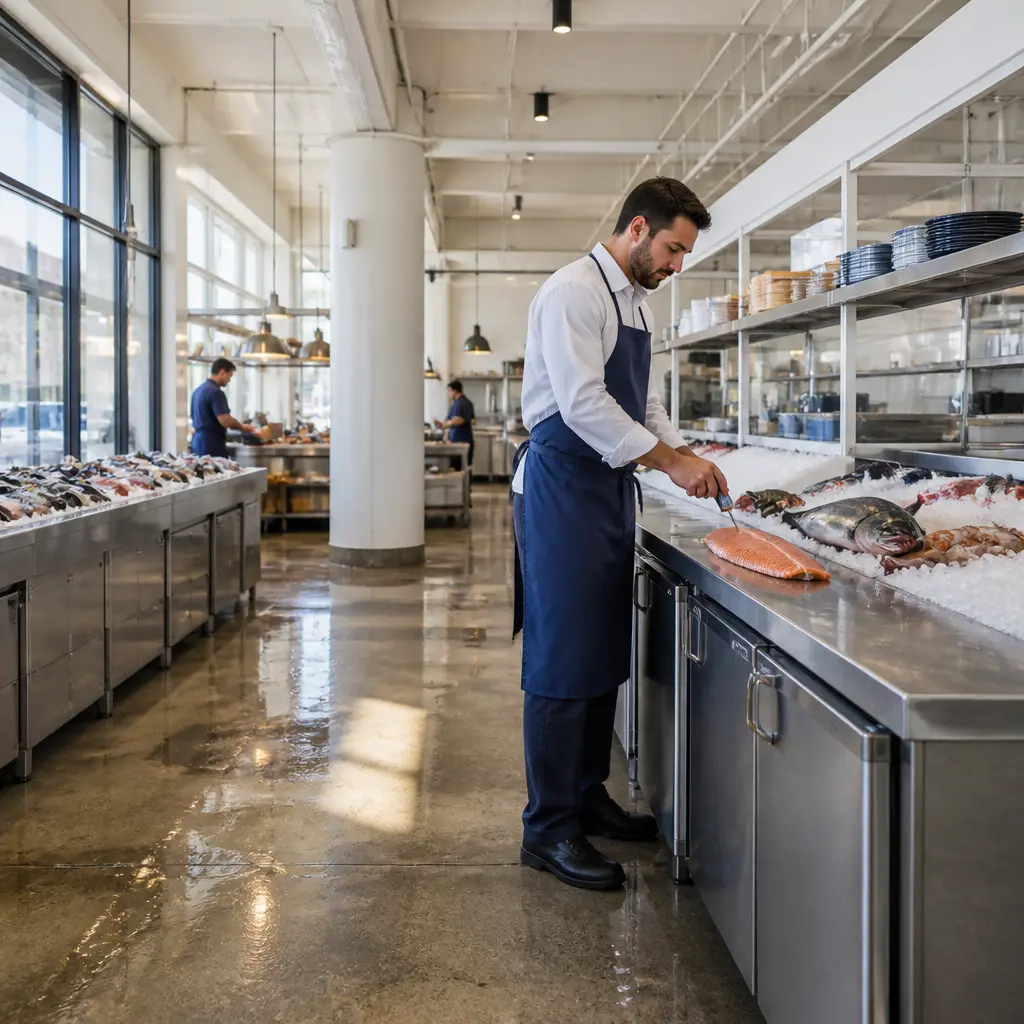
Raw fish quality—shaped by temperature and timing—determines whether seafood becomes a clean, delicate culinary experience or a vehicle for spoilage, parasites, and foodborne illness. Temperature slows microbial growth, freezing can control many parasites, and carefully timed curing, acidification, or cooking changes texture and flavor without making every hazard disappear. The U.S. Food and Drug Administration (FDA) Food Code recommends holding potentially hazardous seafood at 41°F (5°C) or below and identifies specific time-temperature combinations for parasite destruction and cooking. These controls matter as seafood consumption remains substantial: NOAA Fisheries reported U.S. per-capita seafood consumption of 19.3 pounds in 2022.
Temperature controls raw fish quality
Raw fish quality is the combined condition of seafood’s safety, freshness, texture, aroma, appearance, and nutritional value before or during preparation. The FDA describes time-temperature control as a central method for limiting the growth of pathogens and toxin-producing microorganisms in foods that require refrigeration. In practice, temperature does not simply make fish “fresh”; it changes the speed of biological and chemical reactions that determine how fish smells, feels, and tastes.
Cold holding preserves freshness
Cold holding means keeping fish continuously refrigerated, generally at 41°F (5°C) or below under the FDA Food Code. This range slows bacterial multiplication, enzymatic breakdown, and oxidation. It does not sterilize fish or reverse deterioration that has already occurred. A fish fillet that begins warm, remains unrefrigerated during transport, or is repeatedly warmed and chilled can lose quality even if it is later returned to a refrigerator.
The practical goal is a stable cold chain: rapid chilling after harvest, insulated transport, clean storage, and minimal time at room temperature. The FDA recommends that perishable seafood not remain unrefrigerated for more than two hours, or more than one hour when ambient temperatures exceed 90°F (32°C). These limits are particularly relevant for poke, sashimi, crudo, and other preparations served without a final heat step.
Freezing controls parasites, not every hazard
Parasite control is a distinct category of temperature treatment. For fish intended to be eaten raw or nearly raw, the FDA Food Code lists freezing options such as -4°F (-20°C) for seven days, -31°F (-35°C) until solid and for 15 hours, or -31°F (-35°C) until solid followed by storage at -4°F (-20°C) for 24 hours. These treatments target many parasitic hazards, including anisakid worms, but they do not eliminate all bacteria, viruses, toxins, or risks created by poor handling.
Freezing also affects the eating experience. Ice crystals rupture some muscle cells, and slow freezing generally causes more structural damage than rapid commercial freezing. After thawing, the fish may release more drip, feel softer, or show a less glassy appearance. For this reason, high-quality raw-fish service depends on both validated freezing and controlled thawing, usually under refrigeration rather than on a countertop.
Cooking transforms texture and safety
Cooking is a time-temperature treatment that denatures proteins, firms muscle fibers, changes connective tissue, and reduces many living pathogens. The FDA advises cooking fish to 145°F (63°C), or until the flesh is opaque and separates easily with a fork. Lower-temperature methods, including sous vide, can also be effective when the temperature is accurately measured and held for a validated duration; a lower temperature requires more time to achieve an equivalent microbial reduction.
Temperature alone is not the whole process. A thick tuna loin and a thin fish fillet can reach the same surface temperature at different speeds, while carryover cooking can continue after removal from heat. A calibrated probe thermometer therefore provides more reliable validation than color alone. The intended experience—rare, medium, or fully cooked—must be balanced against the vulnerability of the diner and the risk profile of the fish.
Timing transforms raw fish flavor and texture
Timing in raw-fish preparation is the duration between harvest, chilling, cutting, seasoning, curing, thawing, and service. It determines whether a treatment remains a culinary transformation or becomes uncontrolled deterioration. Unlike a single cooking temperature, timing governs exposure: how long microbes can multiply, how long salt can migrate, how far acid can penetrate, and how quickly enzymes can soften tissue.
Immediate handling protects the sensory window
Fish muscle begins changing immediately after death. Endogenous enzymes gradually weaken cell structure, while microorganisms produce compounds associated with sour, sulfurous, or ammonia-like odors. Chilling delays these processes, but it does not pause them indefinitely. In a professional setting, fish is therefore portioned with clean tools, protected from cross-contamination, and returned to refrigeration as soon as possible.
A useful way to visualize the relationship is a conceptual “quality-versus-time” graph: sensory quality generally declines slowly at first under proper refrigeration, then more rapidly as microbial and enzymatic activity accumulate. The curve becomes steeper when fish is warm, wet, repeatedly handled, or exposed to oxygen. This is why a short delay at a fish counter, on a delivery route, or during outdoor service can matter disproportionately.
Acidification creates ceviche but does not equal cooking
Acidification is the use of citrus juice or another acidic ingredient to lower the surface pH of fish. In ceviche, acid denatures proteins, turning translucent flesh opaque and producing a firmer, cooked-like appearance. The visual change is real, but acid does not provide the same validated pathogen reduction as cooking to 145°F (63°C), and it should not be assumed to destroy parasites or every virus and bacterium.
Timing is central to ceviche’s texture. A brief marination can leave the center tender and translucent, while a longer exposure can make small pieces firmer, drier, or mealy. Acid also continues acting after service, so ceviche is best prepared in small batches, kept cold, and consumed promptly. The FDA specifically treats raw and lightly processed seafood as requiring additional attention because acidification, salting, or smoking may not eliminate all hazards.
Salt, sugar, and smoke reshape texture gradually
Curing combines time with salt, sugar, spices, and sometimes smoke. Salt draws out water and changes protein structure; sugar moderates saltiness and can influence surface moisture; cold smoke adds aroma without necessarily reaching a pathogen-destroying temperature. Gravlax illustrates the distinction: its silky texture and seasoned flavor come from controlled diffusion over hours or days, not from conventional cooking.
Curing reduces available water in the fish, but the result is not automatically shelf-stable or pathogen-free. Refrigeration remains necessary, and the duration and formulation should follow a tested recipe rather than intuition. The U.S. Department of Agriculture and FDA both emphasize that preservation methods must be validated because salt, acid, smoke, and refrigeration can suppress some organisms while leaving others viable.
Raw fish safety depends on temperature-time combinations
Food safety is a control system rather than a single freshness test. A safe process considers species, harvest location, parasite risk, handling history, intended preparation, and the people who will eat the food. Temperature and timing work together: colder conditions generally slow growth, while longer exposure increases cumulative risk. No smell test can reliably detect all pathogens or toxins.
Histamine risk can survive later cooking
Scombroid, or histamine, poisoning is associated with temperature abuse in certain fish, especially tuna, mahi-mahi, mackerel, and related species. Bacteria can convert naturally occurring histidine into histamine when fish is inadequately chilled. Once formed, histamine is heat-stable; cooking or freezing may kill bacteria but does not reliably remove the toxin. This makes rapid chilling and continuous cold-chain control more important than attempting to rescue questionable fish at the end of preparation.
The FDA’s seafood hazard guidance treats histamine as a chemical hazard requiring preventive controls. Symptoms can include flushing, headache, palpitations, itching, and gastrointestinal distress, often appearing soon after consumption. A fish that smells acceptable can still pose this risk, which is why purchasing records, supplier controls, and temperature monitoring are more dependable than sensory inspection alone.
Vulnerable diners require a stricter standard
Pregnant people, young children, older adults, and individuals with weakened immune systems face greater consequences from foodborne illness. The FDA and the Centers for Disease Control and Prevention advise these groups to avoid raw or undercooked fish and shellfish, including sushi, sashimi, ceviche, and raw oysters. People with liver disease or other conditions that increase susceptibility to Vibrio infections should be especially cautious with raw shellfish.
For restaurants and home cooks, this means offering a fully cooked alternative and clearly communicating whether fish has been frozen for parasite control. It also means separating raw-fish preparation from ready-to-eat foods, washing hands, sanitizing cutting surfaces, and preventing drips from raw seafood from contacting produce or cooked items.
Species and supply chain change the required control
Not all fish carry the same hazards. Wild-caught species may have different parasite profiles from farmed species, while large predatory fish can accumulate more methylmercury. Geographic harvest conditions influence Vibrio and other microbial risks, and the supplier’s freezing and temperature records determine what additional controls are needed at the point of service.
A real-world example is sushi-grade tuna: the label itself is not a universal legal guarantee of safety. A responsible operation verifies the supplier, confirms appropriate parasite-control documentation when required, maintains refrigeration, and uses the fish within its designated shelf life. The same principles apply to a home cook buying salmon for poke or white fish for ceviche.
Temperature and timing create a deliberate eating experience
The best raw-fish preparation aligns safety controls with sensory intent. Sashimi emphasizes clean flavor, precise knife work, and a firm, cool texture. Poke introduces sauces and garnishes but still depends on cold holding and short service time. Ceviche uses acid for opacity and brightness, while gravlax uses salt and time for a silky, seasoned character. Cooked fish uses heat to produce flaking, browning, and a broader margin of pathogen reduction.
- For raw service, buy from a reputable supplier, confirm parasite-control practices, keep the fish at 41°F (5°C) or below, and serve promptly.
- For ceviche, use properly handled fish, keep it refrigerated, treat acid as a texture and flavor treatment rather than a complete safety step, and avoid prolonged storage.
- For curing, follow a tested salt and time formula, maintain refrigeration, and recognize that cold smoking does not necessarily cook the fish.
- For cooked service, verify the thickest portion with a calibrated thermometer and target 145°F (63°C), unless a professionally validated alternative process is being used.
- Discard seafood with uncertain temperature history rather than relying on smell, appearance, additional seasoning, or later cooking to correct every hazard.
In summary, temperature controls the rate of deterioration and the effectiveness of specific safety treatments, while timing determines how far those treatments—and the fish’s natural changes—progress. Cold holding preserves the quality window, freezing can control many parasites, cooking provides a validated pathogen-reduction step, and acid or curing creates distinctive textures without making raw fish universally safe. Consumers and food professionals can deepen the experience by learning the source and handling history of their seafood, using thermometers and tested procedures, and choosing cooked preparations whenever risk is uncertain.
Sources: U.S. Food and Drug Administration, Food Code 2022, https://www.fda.gov/food/fda-food-code/food-code-2022; U.S. Food and Drug Administration, Fish and Fishery Products Hazards and Controls Guidance, https://www.fda.gov/food/seafood-guidance-documents-regulatory-information/fish-and-fishery-products-hazards-and-controls-guidance; U.S. Food and Drug Administration, Selecting and Serving Fresh and Frozen Seafood Safely, https://www.fda.gov/consumers/consumer-updates/selecting-and-serving-fresh-and-frozen-seafood-safely; Centers for Disease Control and Prevention, About Vibrio Infection, https://www.cdc.gov/vibrio/about/index.html; NOAA Fisheries, Fisheries of the United States, https://www.fisheries.noaa.gov/national/sustainable-fisheries/fisheries-united-states; U.S. Department of Agriculture, Safe Minimum Internal Temperature Chart, https://www.fsis.usda.gov/food-safety/safe-food-handling-and-preparation/meat/safer-food/food-safety-home