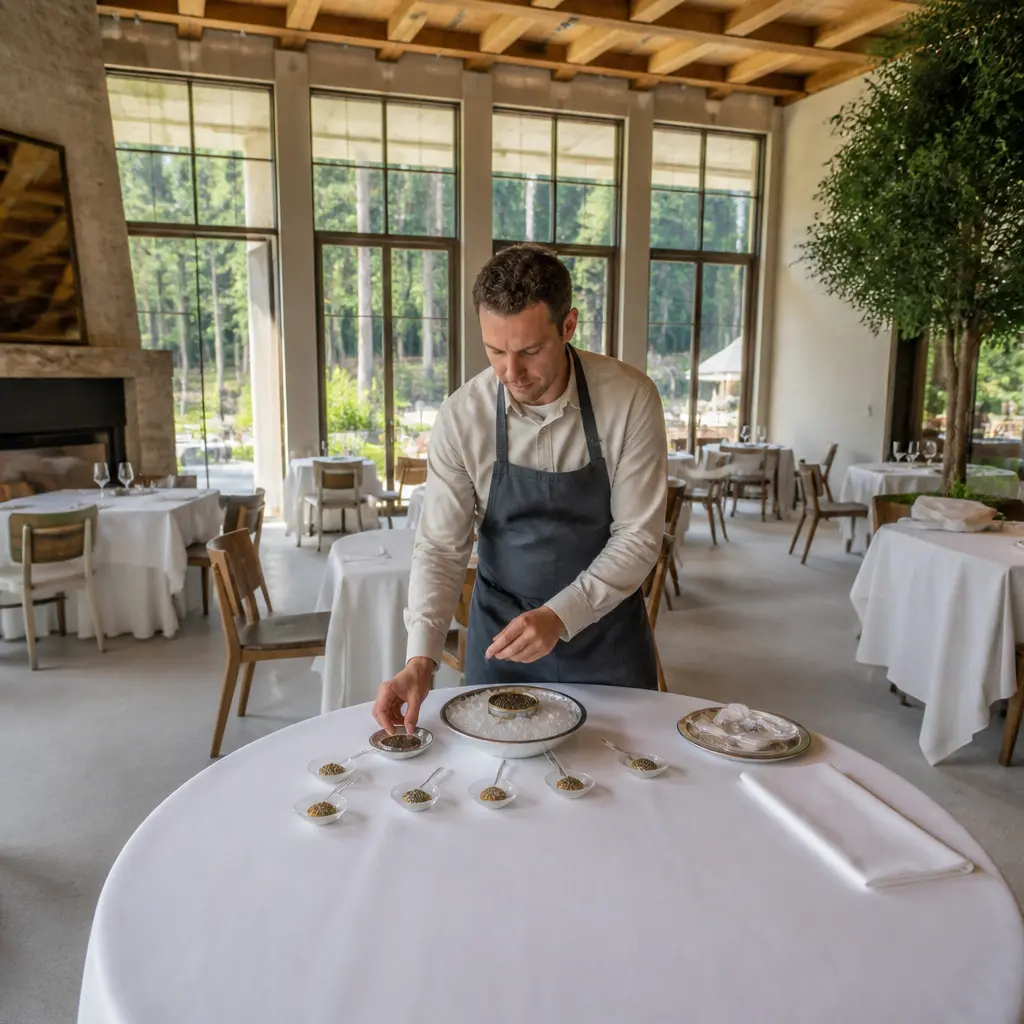
Caviar tasting quality is the combined product, sensory, temperature, service, and hospitality standard that determines whether a tasting feels merely adequate or restaurant-grade. The difference is rarely the price of the roe alone: professional experiences control provenance, freshness, storage, serving temperature, utensil material, portioning, palate preparation, pairing, and guest guidance. The Food and Agriculture Organization reports that aquaculture supplied approximately 130.9 million tonnes of aquatic animals and algae in 2022, illustrating the scale and diversity of modern seafood production; within that market, careful traceability and handling remain central to premium positioning. An amateur tasting can be enjoyable with sound caviar and basic care, while a restaurant-quality tasting turns the same product into a consistent, informative, and multisensory service.
Caviar Tasting Quality Defines the Restaurant-Grade Experience
Caviar tasting quality may be defined as the degree to which a caviar presentation preserves and communicates the roe’s intended sensory character from opening through the final bite. Food-service researchers generally treat quality as multidimensional: the product must meet expectations, the service must be reliable, and the surrounding experience must reinforce value. In practical terms, restaurant-grade quality is not a single flavor score. It is a controlled chain of decisions involving sourcing, cold storage, presentation, pacing, and hospitality.
The principal hyponyms of this attribute are product quality, sensory quality, handling quality, service quality, and pairing quality. These categories overlap, but each answers a different question: Is the roe authentic and fresh? Does it taste balanced? Was it protected from heat and contamination? Was it served with precision? Did the accompaniments support rather than obscure it?
Product Quality and Traceability
Product quality describes the inherent condition and identity of the caviar, including species, production method, salting style, grain integrity, aroma, and freshness. Caviar is traditionally the salted roe of sturgeon, although commercial usage also includes other fish roe products that should be identified more specifically, such as salmon roe or trout roe. A professional tasting begins by naming the species or hybrid, country of origin, farmed or wild status where applicable, and salting method.
Traceability is especially important because international sturgeon commerce is regulated under the Convention on International Trade in Endangered Species of Wild Fauna and Flora. CITES labeling conventions identify information such as species, source, country of origin, harvest or production year, and lot or permit details. These markings do not guarantee that every tin will be exceptional, but they create an accountability framework that an informal tasting often overlooks.
Restaurant buyers also evaluate the roe’s physical appearance. Healthy grains should generally be distinct rather than crushed into a paste, with moisture that looks glossy but not watery. Color varies naturally by species and maturity, so darker roe is not automatically superior. A tin that smells sharply fishy, sour, metallic, or strongly ammoniated is a warning sign; premium caviar should offer clean marine, mineral, buttery, or lightly briny aromas instead.
Sensory Quality and Structured Tasting
Sensory quality is the measurable experience of aroma, appearance, texture, salinity, flavor development, and finish. Professional tasting does not rely on the vague claim that caviar is “good.” It separates the first impression from the mid-palate and aftertaste. The taster may note whether the eggs pop gently, dissolve cleanly, or feel tough and excessively wet; whether salt dominates the fish character; and whether the finish is persistent, bitter, metallic, creamy, or clean.
A useful amateur protocol is to taste a small amount plain before adding any garnish. Restaurant professionals often use a neutral utensil and a controlled portion so that the roe can be assessed without the interference of lemon, onion, crème fraîche, or alcohol. Sensory evaluation literature, including guidance from the Institute of Food Technologists, emphasizes consistent conditions because temperature, serving order, portion size, and environmental distractions can change perception.
A simple tasting chart can record five dimensions on a five-point scale: aroma cleanliness, grain integrity, salinity balance, texture, and finish. The chart should be treated as a comparison tool rather than an objective universal ranking. A lightly salted product may score higher for delicacy, while a more assertively salted product may perform better with blini or sparkling wine.
Caviar Handling Quality Preserves Freshness
Handling quality is the attribute that separates a carefully managed tasting from a casual opening of a tin. Caviar is highly perishable and should remain consistently cold without being frozen. The United States Food and Drug Administration identifies 40°F, or 4°C, as the maximum refrigerator temperature for safe cold storage of perishable foods, while many caviar specialists recommend keeping unopened containers colder, commonly around 28°F to 32°F, depending on the producer’s instructions.
Temperature, Opening, and Time Control
Temperature control means chilling the unopened tin, opening it shortly before service, and returning unused product to refrigeration promptly. A frozen or partially frozen tin can damage texture, while warm caviar loses aromatic precision and may develop a flatter, oilier impression. Professional service commonly places the tin over crushed ice or a chilled presentation surface, but the container should not sit in meltwater.
Time control is equally important. Once opened, the surface is exposed to oxygen, handling, and environmental odors. Restaurants therefore open tins close to the moment of service and track opening times. The exact usable period depends on packaging, salt level, temperature, and producer guidance; a home host should follow the label rather than assume that a partially used tin will remain optimal for several days.
Utensils, Containers, and Cross-Contamination
Utensil quality refers to using materials that do not transfer unwanted flavors. Mother-of-pearl is traditional because it is nonreactive and visually signals refinement. Glass, ceramic, bone, or food-safe plastic can also work. Silver and ordinary reactive metals are commonly avoided because they may create a metallic note, especially in a salty product.
A restaurant-grade setup uses a clean spoon for each variety or tasting round, avoids double dipping, and keeps garnishes in separate serving vessels. The tin’s lid and rim should remain clean, and the spoon should not scrape aggressively against the container. These details have little cost but significantly improve consistency and guest confidence.
Caviar Service Quality Turns Tasting Into Hospitality
Service quality is the way staff or hosts translate a product into an understandable experience. A restaurant-quality presentation typically explains what is being served, how it was produced, how to taste it, and which accompaniments are available. It also manages pacing: guests should have time to taste the caviar plain before the service introduces blini, toast points, crème fraîche, chives, or a beverage pairing.
Portioning and Presentation
Portioning is both a cost-control practice and a sensory tool. Small portions encourage deliberate tasting and prevent the roe from warming on the plate. A restaurant may present a 30-gram tin for a compact tasting or use larger formats for a shared experience, but the meaningful standard is consistency: equal access, clean plating, and enough product for comparison.
Presentation should make the caviar the visual focal point without turning the service into decoration. A chilled tin on ice, a mother-of-pearl spoon, restrained garnishes, and a clear sequence communicate care. Excessive garnish, crowded plates, or warm metal trays can make an expensive product appear less considered and can mask its flavor.
Pairing and Guest Education
Pairing quality measures whether surrounding flavors clarify or overwhelm the roe. Traditional partners such as blini, lightly toasted bread, unsweetened crème fraîche, and finely cut chives provide texture and mild richness. Lemon and raw onion can be enjoyable, but their acidity and pungency often dominate delicate caviar. A professional server offers choices while explaining that the first taste is best taken plain.
Beverage pairing follows the same principle. Brut sparkling wine, dry Champagne, chilled vodka, and crisp mineral-driven white wines can refresh the palate and complement salinity. The best choice depends on the caviar’s salt level and intensity, not on prestige alone. A highly aromatic or sweet beverage can obscure the product even when it is expensive.
Guest education is a defining restaurant-quality feature because it removes uncertainty without imposing a rigid ritual. Staff can explain that caviar is tasted in small amounts, that color is not a simple quality ranking, and that the roe’s texture and finish matter as much as its origin. This converts price into perceived value through transparency and participation.
Amateur and Restaurant-Quality Tastings Compared
An amateur tasting can achieve excellent results with three essentials: a reputable product, uninterrupted refrigeration, and a clean nonreactive spoon. Restaurant quality adds repeatability and orchestration. It controls variables, documents the product, sequences the tasting, anticipates guest needs, and protects the caviar from avoidable sensory damage.
- Amateur priority: buy a fresh, traceable tin and keep it cold.
- Restaurant priority: verify provenance, lot information, delivery temperature, storage conditions, and opening time.
- Amateur priority: offer a few familiar accompaniments.
- Restaurant priority: sequence plain tasting, pairings, beverage service, and comparisons deliberately.
- Amateur priority: serve attractively.
- Restaurant priority: standardize utensils, portions, temperature, garnish, explanations, and cleanup.
The broader lesson is that luxury food experiences are produced by systems, not by ingredients alone. A high-priced tin served warm with a metal spoon can taste less impressive than moderately priced roe handled correctly. Conversely, excellent service cannot rescue product that is stale, poorly labeled, or improperly stored.
Conclusion: Caviar Tasting Quality Depends on Controlled Detail
Caviar tasting quality combines product identity, traceability, sensory balance, cold-chain discipline, nonreactive serviceware, thoughtful portioning, restrained pairing, and informed hospitality. Product quality establishes the foundation; handling quality protects it; sensory quality reveals it; and service quality makes it accessible to the guest. For a home tasting, the most valuable actions are to verify the label, follow the producer’s storage guidance, taste the roe plain first, and keep accompaniments subtle. For restaurants and hosts seeking a higher standard, the next step is to create a written tasting protocol and sensory chart so every tin is served with the same precision. Further reading from CITES, the FDA, the FAO, and professional sensory-evaluation organizations can deepen understanding of traceability, food safety, aquaculture, and structured tasting.
Sources: Food and Agriculture Organization of the United Nations, The State of World Fisheries and Aquaculture 2024, https://www.fao.org/publications/home/fao-flagship-publications/the-state-of-world-fisheries-and-aquaculture/en; Convention on International Trade in Endangered Species of Wild Fauna and Flora, Caviar Labelling and Identification, https://cites.org/eng/prog/sturgeon.php; U.S. Food and Drug Administration, Refrigerator and Freezer Storage Chart, https://www.fda.gov/consumers/consumer-updates/food-safety-home; Institute of Food Technologists, Sensory Evaluation Division Resources, https://www.ift.org/; U.S. Department of Agriculture, FoodKeeper App and Food Storage Guidance, https://www.foodsafety.gov/keep-food-safe/foodkeeper-app