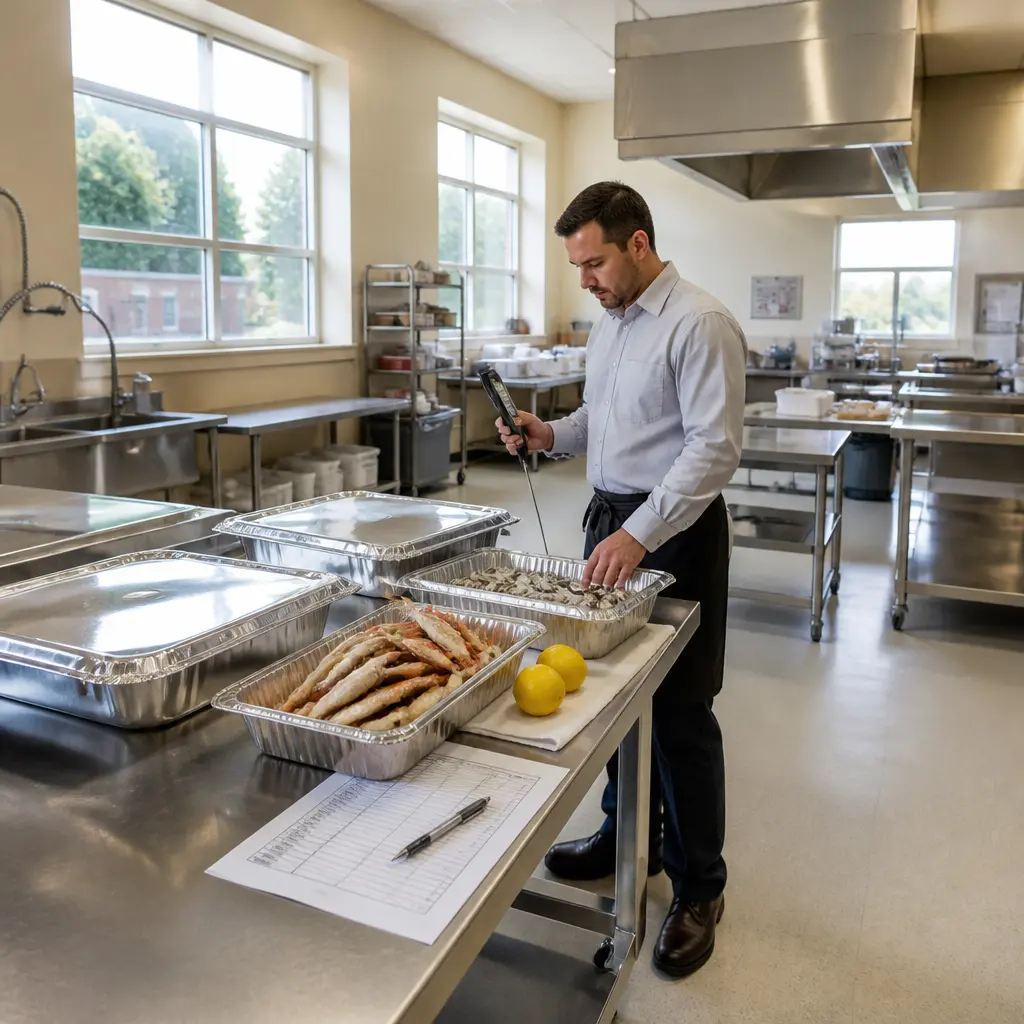
Seafood planning timing is the coordination of purchasing, thawing, cooking, holding, and serving seafood so that quality and food safety are maintained for a large group. The safest approach is to work backward from the serving time, keep perishable seafood at 40°F or below, cook most seafood to 145°F, and avoid leaving it at room temperature for more than two hours—or one hour when ambient temperatures exceed 90°F. These timing rules matter because the Centers for Disease Control and Prevention estimates that about 1 in 6 people in the United States experience foodborne illness each year, while large-batch service creates extra risks through delayed cooking, overcrowded refrigeration, slow cooling, and repeated opening of insulated containers.
Seafood Planning Timing: The Core Attribute of Large-Group Service
Seafood planning timing is the deliberate scheduling of every temperature-sensitive step between purchase and final service. The United States Department of Agriculture defines the food safety “danger zone” as 40°F to 140°F, where bacteria can multiply rapidly. For large groups, the attribute is not simply whether seafood is fresh; it is whether each portion spends as little time as possible in unsafe temperature ranges while still reaching the required internal temperature and desired texture.
The main hyponyms of seafood planning timing are purchasing timing, thawing timing, preparation timing, cooking timing, holding timing, cooling timing, and service timing. These categories are connected: buying seafood too early can increase storage risk, thawing too late can delay cooking, cooking everything at once can overwhelm equipment, and holding food too long can reduce both safety and quality.
Purchasing and receiving timing
Purchasing timing is the interval between acquiring seafood and using it. Fish and shellfish should be purchased as close to the event as practical, delivered cold, and transferred immediately to refrigeration. The U.S. Food and Drug Administration advises consumers to select seafood that is refrigerated or displayed on a thick bed of fresh ice, with flesh that appears firm and moist rather than dry or discolored.
For a large event, divide the order into service-day quantities instead of buying one oversized batch several days in advance. Ask the supplier when the product was packed, whether it arrived previously frozen, and whether shellfish tags or harvest information are available. This distinction is important because “fresh” may describe never-frozen seafood, while previously frozen seafood can still be safe and high quality when it has been handled correctly.
Thawing timing
Thawing timing is the planned period for converting frozen seafood to a ready-to-cook condition without allowing its surface to warm into the danger zone. The safest routine is refrigerator thawing, generally overnight or longer depending on thickness and packaging. A sealed package may also be thawed in cold water, with the water changed regularly, followed by immediate cooking.
A common mistake is moving a large frozen block from the freezer to a countertop on the morning of service. The center may remain frozen while the outside warms for hours. Microwave thawing is suitable only when the seafood will be cooked immediately. Planning should include a backup such as individually portioned fillets or smaller sealed packages, which thaw more predictably than one large mass.
Cooking Timing: Preventing Batch and Equipment Delays
Cooking timing is the relationship between portion size, equipment capacity, target temperature, and serving time. The FDA Food Code identifies 145°F as the minimum internal cooking temperature for many fish and shellfish preparations, while the USDA recommends using a food thermometer rather than judging doneness by color alone. Timing should therefore be based on measured temperature and batch capacity, not on the clock alone.
Batch size and oven capacity
Batch timing describes how long each production group takes to cook and how many groups an oven, grill, fryer, or steamer can process safely. Overloading pans restricts airflow and causes uneven heating, making thin pieces overcook while thick pieces remain undercooked. Before the event, calculate the number of portions per batch, the expected cooking time, the reset time between batches, and the time needed to verify internal temperatures.
A practical schedule might reserve the final cooking period for small, fast-cooking portions while beginning thicker fillets or casseroles earlier. A temperature log should record the time a batch enters the equipment, the time it is checked, and the coldest measured portion. This creates a more reliable control system than assuming every tray cooks at the same speed.
Cooking too early
Cooking too early is a quality and safety mistake because seafood can dry out, lose its texture, and spend too long in hot holding. It is especially problematic for delicate fish, fried seafood, scallops, and shrimp, whose quality declines quickly after cooking.
Instead of preparing the entire order hours in advance, use staggered batches. Keep raw seafood refrigerated until its assigned production window, and coordinate garnishes, sauces, starches, and serving utensils so the cooked seafood reaches guests promptly. If food must be held, maintain it at 140°F or above and monitor the holding unit rather than relying on its thermostat setting alone.
Cooking too late
Cooking too late creates rushed handling, inadequate temperature checks, and long guest waits. It can also encourage unsafe shortcuts such as partially cooking seafood, leaving raw portions unrefrigerated while equipment becomes available, or mixing freshly cooked food with an older batch.
A safer schedule includes a completion buffer before the advertised meal time. For example, if the first guests are expected at 6:00 p.m., plan for the first verified batch to be ready before 5:45 p.m., then continue cooking smaller batches. The buffer allows time to correct a cold spot, replace a failed pan, or adjust for slower equipment without compromising safety.
Holding and Service Timing: Protecting Seafood After Cooking
Holding and service timing cover the period between completion of cooking and consumption. Large-group meals often fail at this stage because serving lines move slowly, containers are uncovered, and staff repeatedly add new food to old food. The safest system uses shallow service pans, covered containers when possible, frequent temperature checks, and replacement pans rather than continuous topping-off.
Hot holding and buffet timing
Hot holding means keeping cooked seafood at 140°F or above until it is served. The FDA Food Code uses 135°F as the minimum hot-holding temperature for food-service operations, while many household food-safety recommendations use 140°F as a simple consumer benchmark. Event organizers should follow the stricter applicable requirement from their local health department, caterer, or venue.
A buffet should be replenished with fresh, smaller pans instead of one deep pan that remains on the line for the entire event. Labeling each pan with its start time helps staff identify which batch should be replaced first. A simple service chart can show pan number, food temperature, time placed on the line, and time removed.
The two-hour rule
The two-hour rule limits how long perishable seafood may remain between 40°F and 140°F at room temperature. The FDA and USDA advise discarding perishable food left out for more than two hours, or more than one hour when the surrounding temperature is above 90°F. This time includes transportation, plating, buffet display, and periods when food sits on a preparation table.
The rule is cumulative. Returning seafood to refrigeration after it has already spent substantial time at room temperature does not reset the clock. For outdoor events, use insulated coolers with ice or cold packs, keep containers shaded, and separate raw seafood from ready-to-eat foods. A service manager should be assigned to track time rather than expecting every volunteer to make independent judgments.
Raw and lightly cooked seafood timing
Raw or lightly cooked seafood requires more conservative scheduling because cooking may not provide the pathogen-reduction step used for fully cooked products. The CDC warns that raw oysters can transmit Vibrio and other pathogens, with higher risk for people with liver disease, diabetes, weakened immune systems, or other medical conditions.
If raw oysters, sushi, ceviche, or undercooked shellfish are offered, keep them cold until immediate service, use a knowledgeable supplier, prevent cross-contact with cooked food, and clearly identify the items for guests. A large event should also provide fully cooked alternatives because guests may not know their personal risk factors.
Cooling and Leftover Timing: Avoiding the Large-Batch Trap
Cooling timing is the controlled reduction of cooked food temperature before refrigeration. Large pans of seafood cool slowly because their volume and density trap heat in the center. The FDA Food Code calls for cooling cooked food from 135°F to 70°F within two hours and from 70°F to 41°F or below within an additional four hours, for a total maximum cooling period of six hours.
Why deep containers cool too slowly
A deep container can remain warm in its center even when the surface feels cool. Divide leftovers into shallow pans, use smaller containers, leave space for air circulation, and use an ice-water bath when appropriate. Stir food with clean utensils where safe and practical, and verify the center temperature with a calibrated thermometer.
Do not place a very large, steaming stockpot of seafood directly into a crowded refrigerator. It can raise the surrounding air temperature and warm nearby foods. The better sequence is to portion the food, vent it briefly in a controlled area, use rapid-cooling methods, and refrigerate it promptly according to the venue’s food-safety procedures.
Leftover labeling and reheating
Leftover timing includes the time of cooking, cooling, refrigeration, reheating, and final disposal. Label containers with the product name, cooking or cooling date, and discard date. Reheat only the quantity likely to be served, because repeated heating and cooling reduce quality and increase handling opportunities.
When reheating for hot service, heat seafood rapidly to the applicable food-service standard and verify the center temperature. Do not use a slow cooker or warming unit as the primary reheating device unless the equipment and procedure are specifically designed for that purpose. When in doubt about how long seafood has been unrefrigerated, discard it rather than relying on smell or appearance.
A Practical Timing Plan for Large Seafood Events
A written timeline converts seafood planning timing from an informal estimate into an operational control. The following sequence can be adapted to a banquet, community meal, wedding, school function, or catered buffet.
- Confirm the guest count, menu, portion sizes, dietary restrictions, cooking equipment, refrigeration space, and local health requirements.
- Schedule delivery or pickup as close to preparation as practical and verify that seafood arrives cold, clean, and properly packaged.
- Thaw frozen seafood under refrigeration or by an approved cold-water method; never plan on countertop thawing for a large batch.
- Assign separate preparation areas and utensils for raw seafood and ready-to-eat foods.
- Calculate cooking batches backward from service time, adding a buffer for temperature checks and equipment delays.
- Cook in staggered batches, measure the thickest or coldest portion, and record results.
- Hold cooked seafood at the required hot temperature or serve it promptly in small, covered batches.
- Track the time each pan enters and leaves the buffet, and discard food that exceeds the applicable time limit.
- Cool leftovers rapidly in shallow containers, label them, and refrigerate them without overloading the refrigerator.
A useful visual aid is a timing chart with five columns: task, responsible person, planned time, measured temperature, and corrective action. For example, a chart might show “shrimp batch two,” “5:20 p.m.,” “146°F at 5:34 p.m.,” and “move to covered service pan.” This functions like a simple control graph: each recorded temperature and time reveals whether the event is staying within its safety limits.
Conclusion: Treat Seafood Timing as a Safety System
Seafood planning timing connects purchasing, thawing, cooking, holding, cooling, and service into one system. The most damaging mistakes are buying too early, thawing on the counter, overcrowding cooking equipment, preparing all portions far ahead, holding seafood too long, and cooling large containers too slowly. Using cold storage at 40°F or below, cooking most seafood to 145°F, maintaining appropriate hot-holding temperatures, applying the two-hour rule, and recording batch times and temperatures provides a practical foundation for safer large-group meals.
Before the event, create a written production schedule, appoint one person to monitor temperatures and time, confirm local food-service requirements, and train every server on replacement-pan and discard procedures. Further guidance should come from the FDA Food Code, the USDA food-safety resources, the CDC seafood illness guidance, and the local health department responsible for the venue.
Sources: U.S. Food and Drug Administration, Food Code 2022, https://www.fda.gov/food/fda-food-code/food-code-2022; U.S. Food and Drug Administration, Selecting and Serving Fresh and Frozen Seafood Safely, https://www.fda.gov/consumers/consumer-updates/selecting-and-serving-fresh-and-frozen-seafood-safely; U.S. Department of Agriculture, Keep Food Safe! Food Safety Basics, https://www.fsis.usda.gov/food-safety/safe-food-handling-and-preparation/food-safety-basics; Centers for Disease Control and Prevention, About Food Safety, https://www.cdc.gov/food-safety/about/index.html; Centers for Disease Control and Prevention, Vibrio and Oysters, https://www.cdc.gov/vibrio/prevention/index.html; U.S. Food and Drug Administration, Fish and Fishery Products Hazards and Controls Guidance, https://www.fda.gov/food/seafood-guidance-documents-regulatory-information/fish-and-fishery-products-hazards-and-controls-guidance