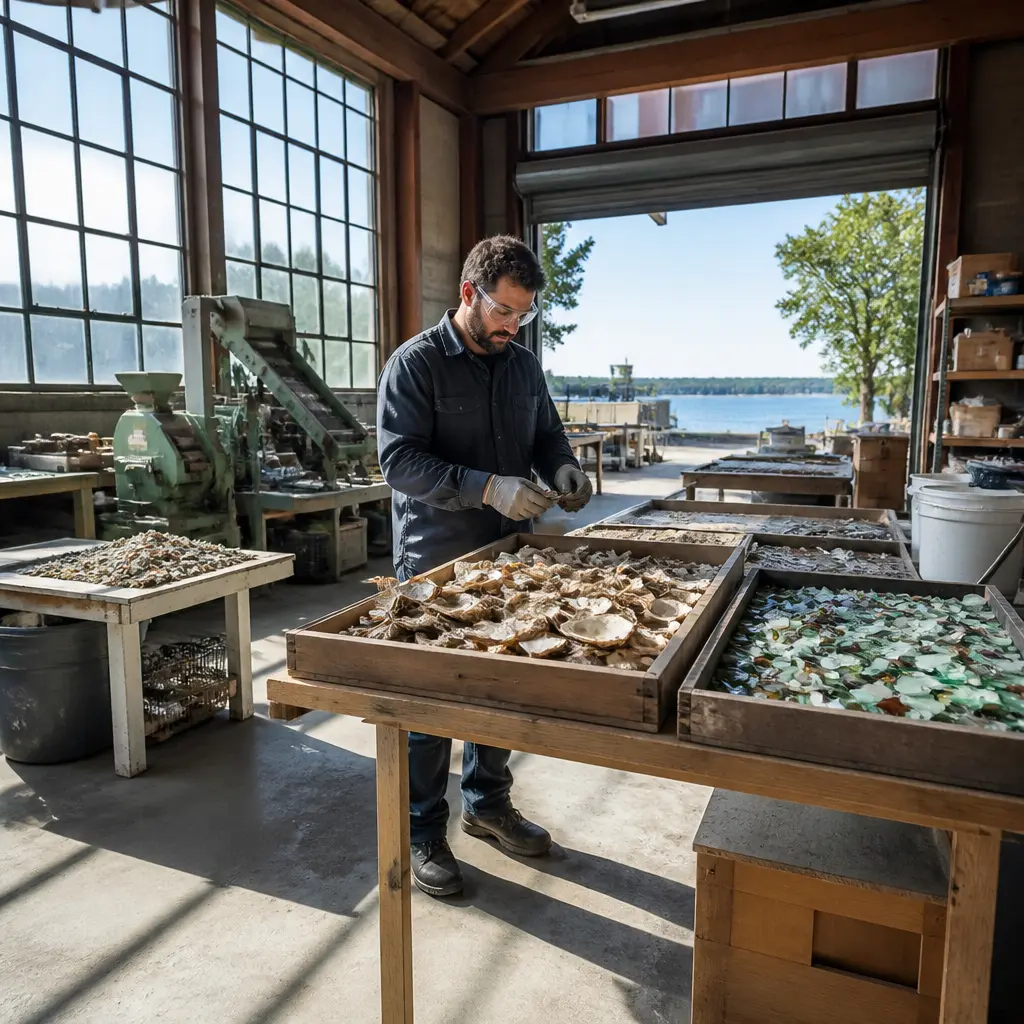
Oyster shell–calcium carbonate is the mineral pairing that links a meal of oysters with the manufacture of glass: the shell is composed mainly of calcium carbonate, while ordinary soda-lime glass combines silica with soda and lime. The shell does not become glass by itself, but its calcium carbonate can serve as a lime-bearing flux or raw material in glass and ceramic formulations. This matters because oyster farming produces substantial shell waste, glassmaking consumes mineral resources at industrial scale, and recovering shells can reduce disposal burdens while supporting circular manufacturing.
Oyster Shell–Calcium Carbonate Is the Mineral Bridge to Glass
Oyster shell–calcium carbonate describes the relationship between an oyster’s hard external shell and its dominant mineral constituent. Calcium carbonate, written chemically as CaCO3, occurs in several mineral forms, including calcite and aragonite. Marine oysters build shells from calcium carbonate extracted from seawater, binding the mineral within an organic matrix of proteins and other compounds.
The United States Geological Survey identifies limestone, a rock consisting primarily of calcium carbonate, as a major industrial source of lime. In glassmaking, “lime” generally means calcium oxide, or CaO. When oyster shells are heated, their calcium carbonate decomposes into calcium oxide and carbon dioxide. The resulting calcium oxide can help stabilize glass, improve chemical durability, and reduce the tendency of a molten silica mixture to dissolve in water.
Oyster Shell as a Biogenic Mineral
A biogenic mineral is a mineral formed or concentrated through the activity of living organisms. Oyster shell is a biogenic form of calcium carbonate rather than a geological limestone deposit. The National Oceanic and Atmospheric Administration describes oyster shells as being made mostly of calcium carbonate, with smaller amounts of organic material and other minerals. Exact composition varies by species, growing conditions, shell layer, and measurement method, but calcium carbonate commonly represents roughly 90 to 95 percent of dry shell mass.
The main shell mineral is not distributed uniformly. Oyster shells contain an outer prismatic layer and an inner nacreous, or mother-of-pearl, layer. These layers use different crystal arrangements and organic structures, giving the shell strength despite the relative brittleness of pure calcium carbonate. This layered architecture is a key hyponym of the broader oyster-shell category: nacre, prismatic calcite, aragonite-rich shell material, and processed shell powder are related but not identical feedstocks.
Calcium Carbonate as Limestone, Calcite, and Aragonite
Calcium carbonate is the chemical entity, while calcite and aragonite are its principal crystalline mineral forms. Limestone is the geological aggregate most commonly quarried for industrial calcium carbonate. Chalk and marble are additional calcium-carbonate materials, differentiated by origin, texture, and geological history.
This distinction explains why oyster shells can resemble limestone chemically while behaving differently during processing. Shells have biological pores, organic residues, variable crystal structures, and often salt or tissue contamination. Before industrial use, shells normally require washing, drying, crushing, and controlled heating. The resulting calcined shell is largely calcium oxide, while unheated shell powder remains primarily calcium carbonate.
Soda-Lime Glass Uses Calcium Oxide as a Stabilizing Mineral
Soda-lime glass is the dominant form of commercial glass used for bottles, jars, windows, and many architectural products. A typical formulation contains approximately 70 to 74 percent silica, 12 to 16 percent sodium oxide, and about 5 to 12 percent calcium oxide, with smaller quantities of magnesium oxide, aluminum oxide, and other additives. Industry formulations vary, so these ranges should be treated as representative rather than universal.
Silica is the glass former: it creates the connected network that gives glass its basic structure. Sodium compounds act as fluxes, lowering the temperature needed to melt silica. Calcium oxide is a network modifier and stabilizer. It improves water resistance and chemical durability, helping transform a soluble or fragile silicate melt into practical container and window glass.
Glass Former, Flux, and Stabilizer
A glass former creates the continuous amorphous network; silica is the principal example in ordinary soda-lime glass. A flux lowers melting temperature, making furnace operation more energy-efficient. A stabilizer strengthens the network against moisture and chemical attack. In this vocabulary, oyster shell is not primarily a glass former. Its useful role is as a calcium-bearing source that can become a stabilizing oxide after calcination.
The distinction prevents a common misconception: an oyster shell is not a naturally occurring piece of glass, and calcium carbonate is not a substitute for all the ingredients in a glass batch. A shell-based recipe still needs a silica source and commonly a sodium source. The shell can replace some conventional limestone or other calcium-bearing inputs, subject to purity, color, particle size, furnace conditions, and product specifications.
Why Heating Shells Changes Their Function
Calcination is the thermal decomposition of a carbonate mineral. For oyster shell, the simplified reaction is CaCO3 → CaO + CO2. The reaction generally becomes significant at temperatures around 800 to 900 degrees Celsius, although the precise temperature depends on particle size, atmosphere, heating rate, and impurities.
Calcination creates a mass trade-off. One mole of calcium carbonate produces one mole of calcium oxide and releases one mole of carbon dioxide; by mass, approximately 44 percent of the carbonate becomes released carbon dioxide, while about 56 percent remains as calcium oxide. This means shell recycling can reduce quarrying but does not eliminate process emissions when the shell must be calcined. The environmental balance therefore depends on transport distance, furnace energy, fuel source, avoided mining, and whether the shell is used without high-temperature conversion.
Oyster Shell Recycling Connects Seafood Waste with Mineral Manufacturing
Oyster shell recycling is the recovery of discarded shells for environmental restoration, agriculture, construction materials, water treatment, or industrial products. The United Nations Food and Agriculture Organization reports that global aquaculture has become a major source of aquatic food, and bivalve production generates shells as an unavoidable co-product. In oyster-growing regions, shell piles can occupy valuable land, create odors, attract pests, and lose material that could otherwise support new oyster habitat.
The strongest circular-economy case does not assume that every shell should enter a glass furnace. Higher-value uses may include returning clean shell to oyster reefs, where shell provides settlement surfaces for oyster larvae. The National Oceanic and Atmospheric Administration and regional restoration programs use recycled shell in reef construction because oyster populations need hard substrate on which juvenile oysters can attach.
Shell-to-Glass Feedstock
Shell-to-glass feedstock is cleaned, size-controlled oyster shell or calcined shell introduced into a glass batch as a calcium-bearing ingredient. Laboratory and pilot studies have investigated shell-derived calcium carbonate or calcium oxide in glass, glass-ceramics, tiles, and related silicate products. These applications typically compare melting behavior, hardness, transparency, density, water resistance, thermal expansion, and color against a conventional formulation.
The principal technical risks are contamination and inconsistency. Residual salt can corrode equipment or affect melt chemistry; organic matter can generate gases; iron and other trace elements can tint the glass; and varying shell mineralogy can change melting behavior. Industrial adoption therefore requires standardized cleaning, compositional testing, and batch control rather than simply adding restaurant shells to a furnace.
Shell-Based Glass-Ceramics and Decorative Products
Glass-ceramics are materials made by controlled crystallization of a glass after melting. Oyster-shell-derived calcium can contribute to calcium silicate or calcium phosphate phases, depending on the rest of the formulation and heat treatment. Researchers have also explored shell powder in decorative glass, tiles, pigments, and composite materials where the sustainability story and distinctive appearance are part of the product value.
These products are hyponyms of shell-derived mineral materials, not interchangeable categories. A transparent bottle, an opaque glass-ceramic tile, and a shell-filled polymer composite can all use oyster shell but require different chemistry and processing. A product claim should therefore specify whether the shell is used as calcium carbonate, calcined calcium oxide, aggregate, filler, or a source of a new crystalline phase.
The Mineral Mystery Has Environmental Limits
The environmental promise of oyster-shell glass rests on substitution and waste reduction, not on the idea that shells are emissions-free. Conventional glass furnaces operate at very high temperatures and consume substantial energy. The International Energy Agency identifies industrial heat and process emissions as important decarbonization challenges, while the glass sector continues to pursue higher recycled-glass content, furnace efficiency, electrification, and lower-carbon fuels.
Using waste shell can avoid some extraction of limestone and may reduce disposal impacts, but calcining shell releases carbon dioxide from the carbonate itself. If the shell is already clean and can be used as a direct calcium-carbonate input, the process may differ from using fully calcined material. A credible life-cycle assessment should compare shell collection, washing, drying, grinding, transport, calcination, furnace energy, and the fate of the conventional mineral source.
A Practical Comparison of Mineral Pathways
- Fresh oyster shell: primarily calcium carbonate with organic residues, salts, moisture, and variable trace minerals.
- Washed and ground shell: a calcium-carbonate feedstock with reduced contamination but continued biological and mineral variability.
- Calcined shell: primarily calcium oxide, produced by heating and releasing carbon dioxide.
- Quarried limestone: a conventional calcium-carbonate source with established industrial specifications and supply chains.
- Recycled glass cullet: already-melted glass that can lower furnace energy demand and is often a more direct route to reducing new raw-material use.
This comparison shows why oyster shells are best viewed as one possible supplementary mineral feedstock. In many applications, recycled glass cullet may provide a larger immediate climate benefit because it avoids both raw-material decomposition and part of the energy-intensive melting process. Shells may nevertheless be valuable where local aquaculture creates a reliable waste stream and where a product can tolerate or benefit from their particular chemistry.
How to Evaluate a Shell-Derived Glass Claim
- Identify the shell fraction: state whether the product contains whole shell, powder, calcium carbonate, or calcined calcium oxide.
- Verify composition: test calcium, silica, sodium, magnesium, iron, salts, moisture, and organic residues.
- Compare performance: measure melting temperature, transparency, strength, thermal expansion, durability, and leaching.
- Account for emissions: include washing, transport, calcination, furnace energy, and avoided limestone extraction.
- Check the alternative use: determine whether reef restoration, soil amendment, aggregate, or recycled glass would produce greater local value.
Oyster Shell–Calcium Carbonate Clarifies What Connects Food and Glass
Oyster shell–calcium carbonate is the biological-mineral pairing at the center of the mystery. Oyster shells are mostly biogenic calcium carbonate; glass is primarily a silica network stabilized by calcium oxide and modified by sodium compounds. Heating can convert shell carbonate into calcium oxide, allowing a controlled portion of a glass batch to come from seafood by-product rather than quarried limestone.
The broader implication is a lesson in materials literacy: chemical similarity does not mean identical industrial behavior. Shell, limestone, calcite, aragonite, calcium oxide, glass cullet, and soda-lime glass occupy different stages of a mineral-processing chain. Their value depends on purity, energy, logistics, performance, and competing uses.
Readers, designers, and manufacturers can support better outcomes by asking for transparent material disclosures, favoring verified recycled content, separating shell waste for responsible collection, and consulting life-cycle assessments before treating shell-derived glass as automatically sustainable. Further reading from the United States Geological Survey, the National Oceanic and Atmospheric Administration, the Food and Agriculture Organization, and the International Energy Agency can provide the scientific and industrial context needed to assess future shell-to-glass projects.
Sources: United States Geological Survey, Mineral Commodity Summaries 2025: Stone, Crushed, https://pubs.usgs.gov/periodicals/mcs2025/mcs2025-stone-crushed.pdf; National Oceanic and Atmospheric Administration, Oyster Restoration, https://oceanservice.noaa.gov/ecosystems/oysters/; Food and Agriculture Organization of the United Nations, The State of World Fisheries and Aquaculture 2024, https://www.fao.org/publications/home/fao-flagship-publications/the-state-of-world-fisheries-and-aquaculture/en; International Energy Agency, Glass, https://www.iea.org/reports/glass; Encyclopaedia Britannica, Glass, https://www.britannica.com/technology/glass; American Ceramic Society, Glass Manufacturing, https://ceramics.org/ceramic-tech-today/glass-manufacturing/