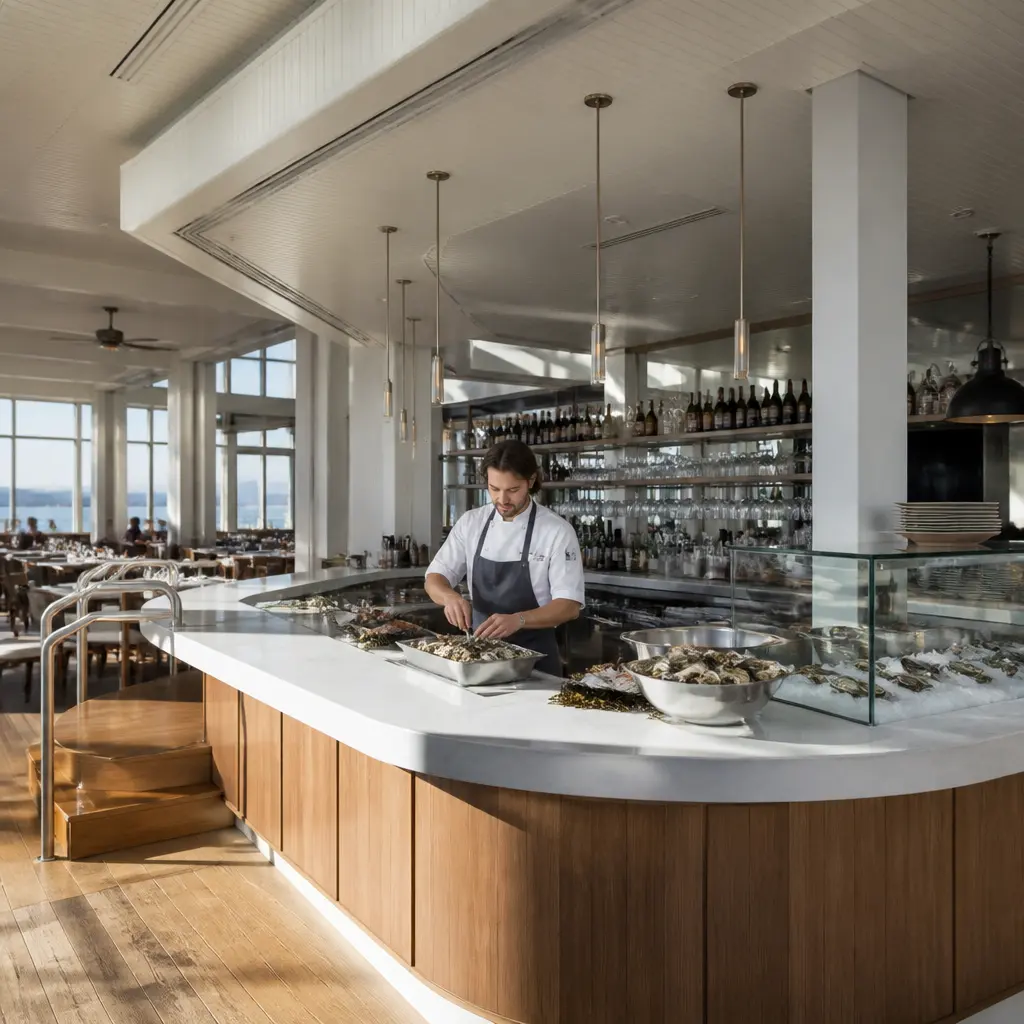
A raw bar is a service counter or menu section devoted to uncooked or minimally handled seafood—especially oysters, clams, crudo, tartare, ceviche, and sashimi. It became an unexpected centerpiece of fine dining because it combines theater, luxury, locality, culinary precision, and relatively low-impact preparation: chefs can display live or freshly shucked products while signaling provenance and seasonality. The shift also reflects broader demand for seafood; the Food and Agriculture Organization reported that global apparent per-capita fish and seafood consumption reached about 20.7 kilograms in 2022. Together, these forces turned the raw bar from a specialist seafood feature into a defining expression of contemporary restaurant culture.
Why raw bars became fine dining’s unexpected centerpiece
The attribute pairing “raw bar as fine-dining centerpiece” describes a restaurant format in which uncooked seafood is not merely an appetizer but the visual, operational, and narrative focus of the meal. The National Restaurant Association identifies local sourcing, experiential dining, and health-conscious choices as important restaurant trends, all of which converge at the raw bar. Its principal hyponyms include oyster bars, crudo counters, sashimi stations, ceviche programs, and shellfish towers.
Unlike a conventional appetizer station, a contemporary raw bar makes freshness observable. Guests can see oysters opened to order, fish sliced in front of them, and shellfish arranged over ice. That visible process helps explain why the format has moved from casual seafood houses into hotel dining rooms, chef-driven tasting menus, and luxury restaurants.
1. Raw bars turn freshness into theater
Freshness is the raw bar’s defining performance. Shucking, slicing, dressing, and plating happen within the guest’s sightline, transforming a kitchen task into hospitality theater. The counter also creates a direct relationship between diner and craftsperson: guests can ask where an oyster was harvested, how a fish was aged, or which garnish best suits a particular species.
This visibility is especially valuable for luxury restaurants because it makes quality legible. A cooked dish can conceal its raw ingredients beneath sauces and techniques; an oyster or piece of crudo cannot. The product, knife work, temperature, and timing are exposed. Restaurants such as Le Bernardin in New York have built enduring reputations around highly controlled seafood preparation, while newer restaurants use open counters to make that precision more social and immediate.
2. Raw seafood carries a powerful luxury signal
Luxury is a second reason raw bars gained prominence. Oysters, caviar, uni, bluefin tuna, langoustines, and chilled shellfish are associated with scarcity, seasonality, and special occasions. A shellfish tower or caviar service can function as a table centerpiece in the same way that a grand cru wine or a sculptural dessert does.
The luxury signal is strengthened by portion design. A restaurant can offer a progression of oysters from several estuaries, pair uni with brioche or rice, or present a tasting of crudo dressed with restrained amounts of citrus, oil, or seaweed. The dish appears simple, but the underlying cost and expertise involve cold-chain management, supplier relationships, species selection, and exact timing. In this sense, the raw bar translates supply-chain sophistication into a visible dining experience.
3. Raw bars express place more clearly than many cooked dishes
A raw bar is also a geography lesson. Oyster flavor varies with salinity, mineral content, tidal movement, and growing conditions, a distinction the industry often describes through the French term “merroir.” Regional oysters from the Pacific Northwest, Northeast estuaries, Gulf Coast, or Canadian Atlantic can differ in sweetness, brine, texture, and finish even when served with minimal garnish.
That direct connection to place aligns with the farm-to-table movement and with chefs’ growing emphasis on traceability. The Monterey Bay Aquarium’s Seafood Watch program has helped popularize consumer awareness of fishing methods and species sustainability, while the Marine Stewardship Council and Aquaculture Stewardship Council provide certification systems that restaurants can use to communicate responsible sourcing. A raw bar therefore does more than serve seafood: it can narrate a coastline, a producer, and a season.
4. Minimal cooking makes technique more visible, not less important
Raw food is often mistaken for effortless food. In practice, the fewer the cooking interventions, the more important selection and precision become. A chef must control receiving temperatures, storage, shucking pressure, knife angle, cut size, acidity, salinity, and holding time. Crudo, tartare, ceviche, sashimi, and oysters each require different decisions about texture and microbial risk.
Food safety makes this precision nonnegotiable. The U.S. Food and Drug Administration Food Code recommends specific parasite-destruction procedures for many fish intended to be eaten raw, including freezing at minus 4 degrees Fahrenheit for seven days or equivalent time-and-temperature combinations. The rule has important exceptions, including certain tuna species and some farm-raised fish, but it illustrates the technical infrastructure behind an apparently simple plate. The Centers for Disease Control and Prevention also warns that raw or undercooked seafood can expose diners to pathogens, which is why reputable restaurants rely on approved suppliers, temperature controls, employee training, and clear consumer advisories.
5. Raw bars fit the economics and social habits of modern dining
The format is economically and socially adaptable. A restaurant can sell a single oyster, a modest crudo, or a premium shellfish tower, allowing guests to enter at different price points. Raw-bar items also pair naturally with sparkling wine, martinis, sake, and low-alcohol aperitifs, supporting beverage sales and encouraging communal ordering.
The counter itself encourages interaction. Diners can sit close to the shucker, watch a chef work, and share plates without committing to a long tasting menu. That flexibility matters as restaurants balance rising labor, food, and occupancy costs. The National Restaurant Association’s industry reporting has repeatedly emphasized that operators are searching for experiences that justify restaurant pricing while remaining memorable and photographable. Raw bars meet that need through high visual impact, modular portions, and a strong sense of occasion.
Raw bar categories and the evidence behind their appeal
Oyster bars: terroir in a half shell
An oyster bar specializes in live or freshly shucked oysters, often organized by farm, estuary, species, or flavor profile. Its appeal rests on comparison: guests can taste how water conditions and cultivation practices affect brine, sweetness, creaminess, and finish. The format makes provenance part of the menu rather than an invisible back-of-house detail.
Crudo and tartare: the chef’s precision category
Crudo generally refers to raw fish dressed shortly before serving, while tartare usually involves finely chopped raw seafood or meat mixed with seasonings. These dishes allow chefs to apply fine-dining technique without obscuring the principal ingredient. A successful plate balances acid, fat, salt, texture, and temperature, making small changes immediately noticeable.
Ceviche: transformation through acid
Ceviche consists of seafood treated with an acidic marinade, commonly citrus, along with aromatics, herbs, chiles, or vegetables. Although acid changes the texture and appearance of fish, it does not eliminate every food-safety hazard associated with raw seafood. Its continued popularity shows how raw-bar cooking can be both culturally specific and globally adaptable.
Sashimi and seafood tasting counters: restraint as status
Sashimi and related tasting-counter formats emphasize species, cut, season, and knife work. The chef’s authority comes from making fewer interventions while choosing exceptional ingredients. High-end Japanese restaurants helped establish this model internationally, and many Western fine-dining restaurants now borrow its counter seating, sequential service, and ingredient-first presentation.
What the raw-bar rise means for fine dining
The raw bar’s rise signals a broader change in what diners consider sophisticated. Fine dining is no longer defined only by elaborate hot courses, formal service, or lengthy tasting menus. It increasingly values transparency, immediacy, responsible sourcing, and participation. A well-designed raw bar can deliver those qualities in a compact format while giving guests a clear view of the restaurant’s standards.
The model also carries responsibilities. Restaurants must communicate species information, harvest location, allergens, preparation methods, and appropriate advisories. They should source from reliable suppliers, monitor temperatures, manage shellfish tags, and avoid presenting sustainability as a vague marketing claim. Diners can support better practices by asking about provenance, choosing seasonal products, and recognizing that “raw” does not automatically mean safer, healthier, or more sustainable.
A useful way to visualize the trend would be a five-part chart comparing the raw bar’s major value propositions: freshness theater, luxury signaling, place-based sourcing, technical precision, and social-economic flexibility. Together, these dimensions explain why the format has become more than a seafood station. It is a compact operating system for contemporary fine dining.
Conclusion
Raw bars became fine dining’s unexpected centerpiece because they make freshness visible, turn seafood into a luxury signal, express regional identity, expose rather than conceal technique, and fit the economic and social patterns of modern restaurants. Oyster bars, crudo counters, ceviche programs, tartare menus, and sashimi stations each represent a different version of the same attribute pairing: raw seafood presented as an experience, not merely a course.
Their broader importance lies in the connection between pleasure and accountability. The best raw bars link memorable service with traceable sourcing, rigorous food safety, seasonal judgment, and respect for marine ecosystems. Further reading should include the FDA Food Code, Seafood Watch recommendations, certification standards from the Marine Stewardship Council and Aquaculture Stewardship Council, and current restaurant-industry reports on consumer dining behavior.
Sources: Food and Agriculture Organization of the United Nations, The State of World Fisheries and Aquaculture 2024, https://www.fao.org/publications/home/fao-flagship-publications/the-state-of-world-fisheries-and-aquaculture/en/; U.S. Food and Drug Administration, Food Code 2022, https://www.fda.gov/food/fda-food-code/food-code-2022; Centers for Disease Control and Prevention, About Vibrio Infection, https://www.cdc.gov/vibrio/about/index.html; National Restaurant Association, 2025 State of the Restaurant Industry Report, https://restaurant.org/research-and-media/research/research-reports/state-of-the-restaurant-industry/; Monterey Bay Aquarium, Seafood Watch, https://www.seafoodwatch.org/; Marine Stewardship Council, What Is Sustainable Seafood?, https://www.msc.org/what-we-are-doing/our-approach/what-is-sustainable-seafood; Aquaculture Stewardship Council, ASC Standards, https://asc-aqua.org/what-we-do/our-standards/